As AI agents quietly take over how consumers discover and buy products, traditional advertising is losing its grip. Branding is no longer just about logos and taglines—it has shifted into the code beneath your website. If you aren’t optimizing for the machine gatekeeper, your business is effectively invisible.
Main Arguments:
- Data is the new branding frontier: To win over AI agents, you must hard-code your brand’s identity, assets, and relationships directly into your website’s structured schema.
- The operational split: Modern branding is dividing into two distinct tracks: Machine-Readability for algorithmic discovery and Product Excellence for human validation.
- The shortcut threat: Consumers will use legacy brands as prompt modifiers, forcing emerging companies to structurally position their data to be recognized as verified alternatives.
Structured Data for Branding Purposes
Let’s address where we are right now in the battle to understand agentic search.
I’ve always argued that it’s about clean data and data maintenance. But it wasn’t until recently that I understood that data, too, is now where branding happens.
I was reading “Why AI Visibility Does Not Only Depend On SEO” by Montserrat Cano when I realized she’s backing up my preaching.
Here’s what I say. Do your normal branding:
- Create designs
- Create logos
- Write your taglines
- Find your mission statements, etc.
But once that’s done, you need to update your website so it’s the absolute source of truth for everything. Add your brand signals to the website as normal, then add schema that provides the true source design, logo files, and links.
Ensure your ORGANIZATION schema is complete. For example:
- Add NAP properties (legalAddress, etc.)
- Use
areaServedto describe to agents where your products and services are available. - Use the
Brandproperty to define the brand. - Add
alternateNameif your brand name is shortened or abbreviated.
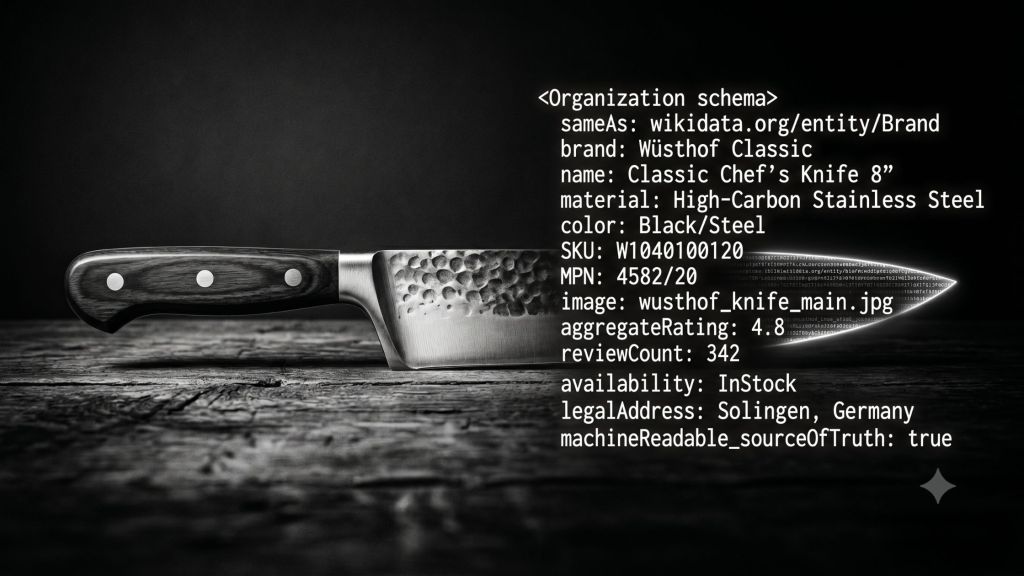
This data mapping needs to go much deeper than just a basic address and company name, though. If you really want an agent to treat your site as the definitive source of truth, you have to hard-code every critical brand asset and relationship directly into your schema.
I’m talking about utilizing the sameAs array to link your homepage to verified external profiles like Wikidata or LinkedIn, forcing AI models to resolve your entity footprint cleanly. It means using Person schema to tether your leadership and authors to their actual, human credentials.
And yes, it even means encoding your visual brand elements—injecting your specific logo and image assets alongside physical identifiers like color and material into your Product or Service markup, right next to hard data like SKUs or GTINs.
Even your content hubs should use reviewedBy and citation properties to tie marketing claims back to verifiable consensus.
By structuring all of this explicitly, you aren’t just decorating a webpage; you’re building a bulletproof data layer that ensures when an agent cross-references your business across the web, the third-party data matches your source of truth perfectly.
The Role of the Brand Engineer
Honestly, this data should be looked at frequently to protect your brand. And as you can see, this is a massive, tedious task. While an agentic workflow could automate parts of it, you will still need a human in the loop to audit how AI interprets the brand and ensure the data is correct.
I’d call this person a Brand Engineer.
They’ll have to understand branding, schema, and how the LLMs interpret this data. They’ll need product experience and deep brand growth skills, mixed with the human skills required to understand the end user.
What is branding now?
This shift makes me wonder if branding is actually splitting into two distinct disciplines: Machine-Readability (structuring data for the agent) and Product Excellence (ensuring the post-purchase experience triggers positive human data signals).
I’d love to pose this question to you all for feedback: Do you see this split happening?
Because here is how the logic maps out: the product or service still has to be useful and over-deliver on expectations. That part isn’t new. But structuring that human-reviewed authority is.
Product excellence creates the raw human sentiment, but machine-readability structures that authority so AI agents can verify its authenticity and map it directly to your brand without entity confusion.
This leads to a theory I’ve been mulling over: Traditional branding has always pushed messages to consumers to create desire. Agentic branding, however, requires pulling unstructured sentiment from consumers via forums, reviews, and video. Because AI agents scrape these organic spaces to evaluate if you match a specific prompt, traditional advertising is completely bypassed.
I’d like to hear your thoughts on this, too: Does agentic branding fundamentally change the direction of how brand sentiment is built?
Where Does Human/Brand Interaction Happen Now?
I’m still having trouble envisioning exactly where humans will interact with brands in the future. I suppose it will be at the physical user level.
- Does this knife stay sharp and make chopping or cutting easier?
- Does this computer help me interface with AI agents better than another?
- Does this TV have a better picture than others?
I suppose this is where brand will still affect us. But finding those products will change.
Imagine prompting an agent: “
I need a chef’s knife. I can spend $150. I want it to be 10″ long. I want its blade and tang to be one piece, with a wooden handle. I want it to be gold, and I need it by 4 PM tomorrow. Get me the best human-reviewed knife available with these features.”
And bang… the agent finds the knife, purchases it, and it arrives.
In this prompt, I didn’t care about the brand during the transaction. I’ll notice the brand when I’m using the knife, and I’ll leave a review somewhere that feeds back into the agent’s data loop.
But there’s another layer to human nature.
We love shortcuts. Instead of typing out a long list of specs, a consumer is highly likely to prompt:
“Get me a chef’s knife like a Wüsthof, but under $150.”
If consumers use legacy brands as shortcut modifiers to reduce agent error, then emerging brands have to structure their data so agents recognize them as direct, verified alternatives to those established giants.
If building a brand now means optimizing simultaneously for a human’s post-purchase experience and an agent’s algorithmic shortcut, then the core playbook hasn’t been burned—it’s just been translated into a new language. We are still building trust, identity, and utility, but we now have to pass a strict machine gatekeeper just to get the chance to prove it to a person.
So, here’s my final question: Does this actually change branding at all? Or does it just change who we are branding for?

