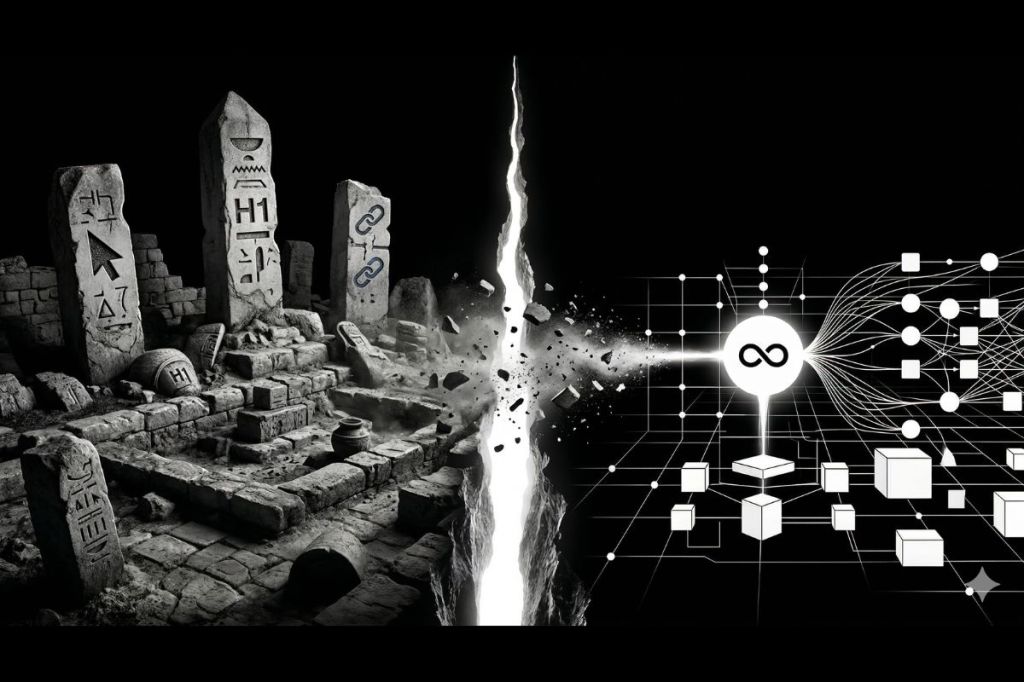
I called the 2022 release of ChatGPT the equivalent of a nuclear bomb. But I think it’s more appropriate to think of it as the Big Bang.
Whatever was there before it immediately ended, and something entirely new formed from the remnants.
It’s been a few months since I’ve updated here, and digital marketers are still up in the air about how to measure and work AI search into their digital marketing ecosystem.
Everyone seems to be an expert; nobody is believable. I’m seeing some of the big players doing the work, running test after test, and showing the data.
But it all boils down to this one thing:
Digital marketing pre-2022 is a Lost World. It’s like Atlantis, or Mesopotamia.
There’s evidence that something great once existed, but it’s hard to imagine how it functioned or what day-to-day life was like.
Maybe scientists and historians should give this era we’re now in a new name…IDK.
Maybe something like:
- B.A.I – Before AI
- A.A.I – After AI
The AI-search Change
My gut feeling is that SEO SaaS companies and any agency offering search engine optimization are no closer to figuring out how search works or how to get traffic to sites.
To further complicate matters, it’s hard to predict when your company will appear first in AI search results. You could literally ask AI the same question in succession, and get slightly different answers each time.
AI doesn’t rank sites, but it does keep certain well-structured, trustworthy sites in what’s called a retrieval-augmented generation (RAG) layer.
Sites eligible for that layer are more likely to be cited in generated answers.
Sheez…since I’m saying the word “site” and “cite” so much, I guess I should take a second to tell you about my newsletter [ ]Cited.
I cover all things AI-search-related as I learn, as new developments happen, as new models are trained, and as any other relevant news emerges.
5 Things To Know About AI-Search
These are your takeaways for today:
- Stop wondering if LLMs are mentioning you; assume they are, and start planning for how that affects your business.
- Users don’t click into your site as much.
- Stop worrying about B.S. vanity metrics like impressions, rankings, and CTR. These were never solid metrics anyway.
- Marketers must STOP trying to shove AI-search into their understanding of SEO. It still matters, but not like it did in 2022 B.A.I.
- AI search is changing rapidly, so get used to that, and make sure your marketing team is agile.
1. Getting mentioned by AIs.
We’ve shifted from a keyword-and-content game to a structure game.
There’s a lot to be done; structure relates to your technical site structure, your content strategy, and your branding.
LLMs will look at all of this.
It’s why Penpixel Creative helps companies measure and secure visibility in the AI discovery layer, where customer journeys now begin.
2. User clicks have dropped to nil.
“AI-generated answers increasingly serve as the first interaction with information, reducing the need for traditional clicks and changing how users access websites and products.”
I can’t remember the last time I actually clicked on a generated answer and went to a website in this new A.A.I era. If you use AI search regularly, I challenge you to think back to when you had to click into a site.
Granted, I’m not a big online shopper, and when I do shop, it’s on Amazon. Hate me if you want, but I don’t like to put too much thought into shopping.
The drop in user clicks only reinforces the importance of ensuring your entire brand is structured for AI search.
3. Vanity Metrics
Full disclosure: I never cared about rankings. I cared about revenue and ROI.
I couldn’t care two bits about where I rank, but that was the name of the game in SEO and what I was paid for, so I was forced to care because my clients did.
Yeah, the psychology and numbers suggested that ranking at the top helped, but it was always smoke and mirrors.
Impressions was another that I never fully got on board with. Who cares how many times you appear in a feed if they scroll right by you?
Logically, there was never a satisfactory way to tie these metrics to ROI, revenue, or success. It was all speculation.
4. AI search builds on SEO, but it’s not SEO
Early in the A.AI era, I realized that doing SEO for search rankings no longer mattered. SEOs are still trying to sell this idea. There are tools that still talk about rankings.
I want you to stop using the terms “optimization” and “rankings.”
In fact, think back to the B.A.I. years, SEO ruined the internet.
That, and Google trying to figure out how to add more and more paid ads to every touchpoint.
Technical SEO still matters. It always has. From day one of the internet, having a structurally healthy and sound website was priority number one.
That’s why search engine optimization and rankings are dead.
We’re no longer optimizing for rankings, clicks, or impressions…we’re structuring your site and brand for better understanding, trust, verifiability, and eligibility for the RAG layer.
5. Digital marketing has changed. Period.
It’s funny reading Search Engine Journal and Search Engine Land and scrolling on LinkedIn.
It reminds me of that Michael Jackson meme, the clip from the movie theatre scene in the Thriller video where he’s happily eating popcorn as he watches the horror unfold on-screen.

There’s so much back and forth about what’s right and wrong, what’s going to happen, what the logic is, what the data shows…
It’s fucking exhausting.
All that’s really happening is that EVERYONE…
AND I FUCKING MEAN EVERYONE…
is running around like a chicken with its head cut off because they’re afraid AI is going to steal their job, replace them, etc…
AI isn’t going to steal your job.
It’s going to make you use your brain more.
You’re now a problem-solver, not a task rabbit.
You’re no longer in a comfort zone where things are repetitive and easy.
Your logic, experience, knowledge, and ability to apply tools to the right situations are what your job is about.
You no longer have the option to log in, automate your day, and watch Netflix in the background.
You’ve got to actively improve yourself, which means your marketing team is now a think tank; it’s no longer
- A project manager/account rep/biz dev
- An SEO who doubles as a content writer/PPC specialist
- A social media/video/audio/graphic artist/backup content writer/PPC specialist
- A developer/technical seo/graphic artist
Or, if you’re big enough, a team with each of those positions filled.
AI does ALL of that for you now.
The marketing teams who make it through the AI apocalypse will be those who can think and problem-solve their way out.

OK. That’s the state of online marketing for now. Stay tuned. I’ll try to pop back in more often. This is fun for me. Looking forward to all questions and comments.
Follow me over on LinkedIn, where I’m all professional and stuff.
 Deven Bhagwandin