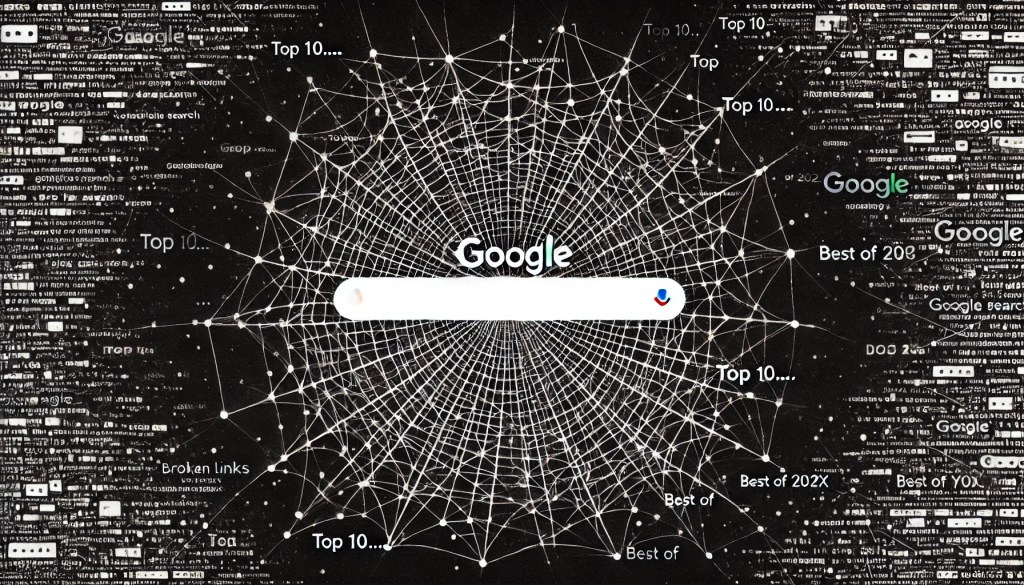
It was inevitable that the internet would become a cesspool and shithole of misinformation, selfish self-promotion, and a haven for illegal activity.
Why?
Humans have a tendency to take whatever is good and turn it into something that causes pain and suffering.
But there’s something worse on my mind: I may have helped to contribute to all of this.
Here’s something else, though. You did, too.
We all did.
We’re all guilty.
Why Are People Arguing that Google Ruined the Internet?
Be honest. Have you ever clicked on an article because the headline seemed too crazy to be true?
Have you ever clicked into a list called “The Best [something] of 202x?”
Have you ever searched for “[something] near me?”
Don’t lie. You have.
I know you have because, just like anyone else, I have access to Google Ads and Google Analytics 4. These tools are essentially gateways into all…wait…some of the data Google keeps on user habits.
BTW, every single website and app you use collects user data. That’s what cookies are. They’re the little code snippets on each site or app that collect data about you.
Marketers like me use this data to segment you into nice little groups or cohorts. Then, we send you ads tailored to your preferred communication style.
We also use that data for search engine optimization (SEO).
Now, we will use your data for generative engine optimization (GEO).
SEO is a practice and skill that uses data collected to tweak websites and content so that they appear higher in search results.
SEOs do this because we’ve discovered (using that same data) that humans are lazy and don’t like searching hard for information. We want it quickly, and we want it to appear in front of us right away.
And AI can generate that content instantly.
For 15, 20 years or more, SEO is how links appear at the top of search engine results. It’s also why you see more ads and less clickable links.
Now, it’s how generative search (in the form of Google Gemini and Bing) knows what pages to reference content from to deliver an AI-generated answer to your search query.
But SEO has been exploited.
It’s been exploited so much that even those who thought they’ve been doing ethical SEO have also had a large hand in ruining the internet.
We’re the reason false information is spread.
We’re the reason it seems the world is getting dumber.
We’re the reason people are locked into their own echo chambers.
It’s all because we found a way to…how do I say this? I’ll continue using the word “exploit.”
We’ve found a way to exploit the algorithm originally intended to make our lives easier.
What Google is Saying
Google insists you should not make improvements for the search engine. Instead, make improvements based on your user data. But is this just a cover-up?
They also insist that we “focus on consistently creating high-quality content and not to focus on optimizing for algorithms. Focusing on quality should be the priority.” – Danny Sullivan

What Is High-Quality Content Anyway?
I mean, this still seems so vague. There are the benchmarks that Google’s Guidelines provide. But I’m skeptical that this even really matters because I think that “high-quality content” is subjective to the audience and topic.
If it’s academic content, we would all imagine it should be written by an expert who has experience with the subject and is regarded as a trustworthy authority, right?
But what if it’s a subject that a high-school teenager would care about? Something that has to do with our rapidly evolving pop culture. Who’s the authority on that?
I mean, think about it: This audience has a totally different way of communicating, vastly different from the academic audience.
Is it another teenager? Is it a fashion magazine that’s taken the time to build its brand so that teenagers regard it as a trend-setting publication?
What about politics? Or sports? Or cooking? Or music?
Wouldn’t “high-quality content” change with the subject?
Conclusion
I think I’m finishing up with more questions than answers. I’m OK with that because I really want this to be more of a discussion. I’m not THE expert, but I’m one of many hundreds of content strategists and SEOs. I also have my own theories on what SEO has become.
Don’t forget that I didn’t even elaborate on generative search optimization (GEO). I’ll get to that soon because it’s increasingly on my mind.
 Deven Bhagwandin