The game has changed. To be successful at outbound sales today, you need a repeatable, scalable process for building real and genuine relationships with your ideal buyers. You need to reach your customers where they are — across multiple channels. And you need a way to measure and optimize your process to continually improve.
I imagine that when Rome fell, hundreds of buildings with those beautiful Doric, Ionian, Corinthian, and Tuscan columns crumbled as barbarians ransacked the city of its riches.
That’s sort of where my business was after five months.
Crumbling.
But I’ll admit. I wasn’t putting my full efforts into my sales cycle. I wasn’t trying to generate leads with ambition or purpose.
I was just half-assing it…
Enough analogies. You get the picture.
With this in mind, I hit the reset button and decided to bone up on my sales skills, something that other SMBs must do as they grow their businesses.
Here’s what I found.
Problem #1: It’s Hard Being a “Full-cycle Salesperson”
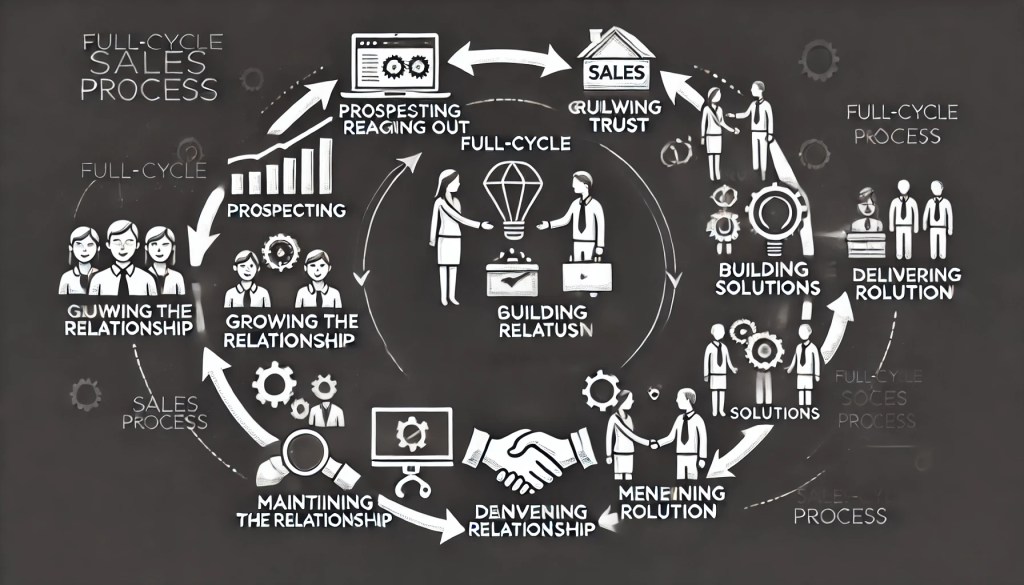
A “full-cycle salesperson” owns the entire sales process from end to end, which SMBs should be very used to. As a full-cycle salesperson, you’re responsible for every step of a customer’s journey.
That means:
- Prospecting.
- Reaching out.
- Growing the relationship.
- Building trust.
- Offering solutions.
- Delivering solutions.
- Maintaining the relationship.
- Renewing the relationship.
Simply put, as an SMB who’s just starting up, you’re responsible for all those bullet points plus marketing and brand building, providing the services and operations you’ve promised, all customer service, and all financial management and accounting.
Hopefully, you have help, unlike me when I started out.
I was alone.
So, I was having trouble managing this, which is embarrassing, but it also gave me good insight into my client’s struggles. I was able to rethink how I approached all of my content, emails, and services.
Problem #2: I Haven’t Been Connecting With People Meaningfully
“If you don’t hunt, you can’t eat.”
— Michelle Outlaw
I was wasting my time, money, and skills reaching out to people who had ZERO interest in working with me then. Pair that with my un-focused approach and my dissolution with SEO and online marketing in general…and it’s no wonder I lost ambition and had zero clients.
So, what exactly was it that I was offering?
That’s an excellent question.
To finish the analogy, what was I hunting with? What was I doing to capture my “prey,” and what “weapons” was I hunting with?
I hoped my emails and reputation would be enough to land a client or two…then I could parlay those into 5-6 more and stay small.
But that wasn’t happening.
A large part of me knew that offering content writing was sort of crazy in the ChatGPT/Claude/Gemini and more age.
I asked myself, “Should I change tack and rethink my services? And should I finally get over myself and start posting more on social media and start a YouTube channel?”
I think the biggest issue I had was I wasn’t networking enough.
I was in the awareness phase of my startup, but I wasn’t doing anything to create awareness ABOUT my company. I had zero content strategy, no social media going, and I wasn’t even posting content on my company site to drive some organic traffic.
I also made the mistake of paying for a year upfront for my cold email marketing SaaS. Four months into it, I still hadn’t booked a single meeting from my cold email outreach.
Guess what that forced me to do: I had to spend a lot of time readjusting my cold email strategy. I used to be very good at this, but now, it’s all changed. AI-generated content and emails causing inbox overload make getting through to a prospect virtually impossible.
You’ve got to approach them from several different angles with differing strategies.
Problem #3: Who Do You Think Could Use Your Service/Product?
It’s important that you create an ideal customer profile (ICP). SMBs like me typically have this client in mind but don’t always take the time to conceptualize and write it down.
This is why it’s a tough question during initial meetings when I ask leaders who their ideal client is. But if you don’t do this, you’ll quickly lose track and waste time going after any and everyone who’ll listen.
Knowing your ICP sets you up for success from day one. Your employees or future employees will know who they’re supposed to target, and your company messaging will be directed to the right audience.
You should also consider creating a lead-scoring framework. This framework ranks your leads or potential clients so you know how close each is to your ICP.
This system helps narrow down the type of person you’re reaching out to, increasing the probability of a sale, and decreasing the amount of time (and possibly money) you put into creating the account.
Keep On Keeping On
One of my character flaws is giving up when the going gets tough. I’ve taken lousy advice and quit jobs or passion projects too early. I’ve gotten financially scared or stressed and lost my nerve. And sometimes, things just didn’t happen as quickly as I thought they would, so I gave up when things got tough.
Don’t fucking do that. Stick with it. Especially now, when there is so much free content online, people are willing to help. This applies to me as much as you. Let me know how what you do to overcome your startup struggles by contacting me or leaving a message.
 Deven Bhagwandin