The launch day banners, balloons, and hors d’oeuvres are all in place near your business’s entrance.
The lights are on, and people begin to trickle in. But it’s not who you expected.
These aren’t the people you envisioned when you spotted a need in your community, dreamed up your business, planned the services and products, chose a color palette, and designed a logo and website.
Where did you go wrong?
Why isn’t this the clientele you expected?
Did you put thought into your clients, or did you assume your services or products would attract the right audience?
Those may seem like obvious aspects you should consider during business planning, but business owners like you and me commonly overlook them.
How I Started To Find My Target Audience
I decided that I wanted to work with startups and small and mid-sized businesses because I enjoy helping others, providing a service, and building something.
I really enjoy helping someone achieve their dreams, and I like the flexible and adaptable mindset new business owners tend to have.
As I was maturing in my professional life, I worked with several corporations and was always impressed with how they put systems in place to ensure efficiency and profitability.
But I also feel gross writing the previous sentence.
It’s almost as if I can feel my T-shirt, jeans, and slip-on Vans being replaced with a golf polo, khakis, and oxfords.
But inevitably, that’s where startups and small and mid-sized businesses want to get to, and kudos to them.
It’s all about making that money.
I Initially Didn’t Think That a Target Audience Mattered…
Knowing that I wanted to “work with startups or small businesses,” I began pitching my copy and content writing skills across the internet.
My process was this: I’d literally bounce around the internet like a ping pong ball, typing random search terms into the search bar, looking for businesses that I thought I could write for.
One minute, I was pitching myself to a marine supply company; the next, to a new restaurant in Denver; and later, to an oil and gas pipeline manufacturer here in Houston.
My mindset was that I needed money, believed in myself and my services, and could figure enough out about the business, industry, and topic to deliver excellent content.
I leaned on my grammar and writing skills to accomplish this.
…and That Backfired Quickly
Over time, this approach began to backfire for two reasons:
- It limited the type of content I was writing to the top-of-funnel, basic awareness content, which meant…
- I was limited in the rates I could charge.
Top-of-funnel content, or TOFU, as I laughingly enjoy calling it, is the content that users need when they’re just starting their customer journey.
It answers the what, how, and why of your product- or service-related questions. For example:
- What is a target audience?
- How do I determine my target audience?
- Why should I have a target audience?
The purpose of TOFU content is to get your brand name out there, entice readers to click on your content, and then lead them to the next stage in your marketing funnel with cleverly placed information and links.
But it doesn’t typically require a subject matter expert or insider because it doesn’t typically deal with industry- or business-specific topics, and it’s not meant to entice a reader to make a decision at this point in the relationship.
Because TOFU content is generally considered easier to write, lower-skilled or inexperienced writers can handle it, which means you can pay lower rates for this type of content.
You’ll notice that AI-generated content has taken this content type over.
How To Find Your Target Audience
So, let’s talk about how you can avoid casting too wide of a net, ensuring you’re earning a livable rate for your products or services.
Build the Foundations of Your Target Audience
What is a target audience? I say it’s the people that your brand, product, or service can help.
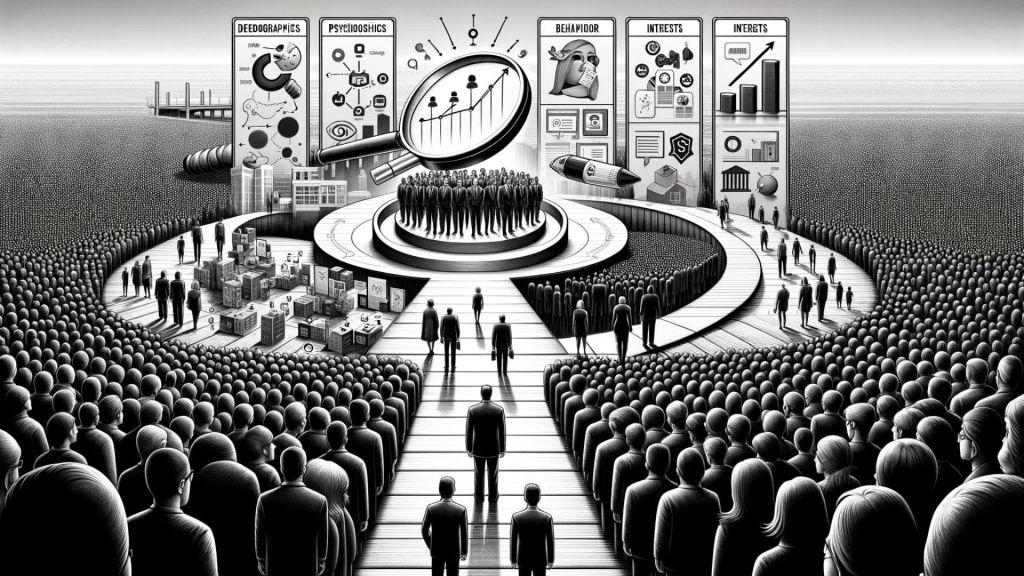
When determining your target audience, consider the following:
- Demographics
- Psychographics
- Behavior
- Interests
- Pain points
You can further break each down into further categories. For example, you can break demographics down into age, race, gender, location, income, marital status, etc., if that information is important to your brand.
Unfortunately, as much as we want to say some of the main and sub-categories on that list don’t matter, they do. These information points allow you to tailor your message so you’re speaking directly to each person in your audience.
These data points ensure you use the correct voice, tone, vernacular, and phrasing. It’s the difference between associating with your audience and its pain points and quickly turning them off.
Don’t Make Assumptions When Identifying Your Target Audience
I had to work extremely hard to learn to identify my target audience. Honestly, I think it’s because of my ego and can-do attitude.
I like to think I can talk to anyone because I’m proud of my knowledge and ability to learn new topics quickly.
But remember, I told you that this got me into a lot of trouble and stalled my business. Here’s what I finally had to do to get this right.
Initially, I kept it simple and formed a mental picture of the person in my head…
Research Your Target Audience’s Needs
…but I went further and did research on the average prices competitors or peers were charging. This information allowed me to determine their education and income level. Ideally, only those who can afford goods will buy them.
These characteristics also helped me determine a general age, which in turn allowed me to determine how to message this audience (you’ll talk to a teenager differently than you’ll talk to a sixty-something-year-old).
Next, I took the product or service I was strategizing for into account and really brainstormed on why the audience would need this service.
If I knew someone who fit all of these characteristics, I would show them the product or service and get their initial thoughts on TOFU content or content that would entice them to buy a product instead of a competitor’s.
Besides my ego, another reason I skipped this step is that it’s freaking time-consuming.
Your job is to create content, and your client expects you to create content quickly because they want sales NOW.
There are several companies dedicated to doing this research, or you can use AI to do it. If you have data on your target audience, you can plug it into AI and simply ask it to identify characteristics and topics your audience would be interested in.
AI can help with analysis and market research. It can even help with social engagement and competitor research.
I’d personally recommend carefully considering how you use AI to engage with your audience.
Modern audiences are extremely savvy and can feel when they’re talking to a chat-bot or getting generic, AI-generated responses to their conversations.
Your Target Audience Wants You To Engage With Them
I strongly believe that knowing your audience means engaging with them regularly. It’s like seeing friends.
I have a friend that I used to hang out with every day, so we had little inside jokes and could pick up a conversation a day after talking about a topic by simply mentioning a trigger word.
But then we didn’t talk for several months because I got busy with my new job.
When we were finally able to hang out again, we had a hell of a time getting back into the swing of things because it was awkward.
We had changed a bit, despite it being only a few months. We had new things going on in life, so we had lost that “touch” that made a deep friendship.
To this day, we don’t hang out or talk as much as we did.
Ignoring or disengaging from your target audience causes this same issue.
When you engage with your audience, you find commonalities, know what they’re into, what they’re interested in, and what their problems are, and you’ll have a common language with each other.
You create engagement by reaching your audience through multiple channels. Social media, search topics, blogs, podcasts, YouTube videos, and shorts. All of these are part of the larger conversation, and you should think of these channels that way: As part of the entire conversation, not siloed.
Your audience wants their information any way they can get it.
One minute, they may be using their phone to look up some TOFU content, but then find out that you have a YouTube video or podcast where they can find out more details.
Or they may get busy and put you out of their mind for a few days, and then see an email, or your ad, or a post on social that reminds them to go back to the stage in their customer journey where they left off.
You’ll want to be there when they’re ready for you.
Finding Your Target Audience Takes Time, but It’s So Worth the Time Spent
Here’s what I learned about finding and keeping your target audience: Take the time to learn about them, and then take the time to engage with them.
I once helped a small marine supply company modernize their business by creating a web-store and helping them market their brand.
I don’t have exact figures, but I worked in-house on this project and visibly saw their warehouse get busy enough to need more employees to accommodate all the new orders and goods arriving.
As I engaged with customers on the phone, in person, and on social media, I heard more and more say things like, “We didn’t even know you were here until we saw your website and your Facebook posts!”
They were all thankful and happy to learn there was a small business in the area they could support instead of frequenting the big box stores or chains.
The marine supply company was already well established, but this bump in business levels allowed the owners to retire and turn operations over to their children.
They now spend their time traveling and with their grandchildren.
So, getting it right with your target audience creates new customers, lifelong customers, and brand advocates who do the work of building your brand for you because they genuinely like you.
I’ve literally seen this with my own eyes.
All of this leads to a successful business. You may find you don’t enjoy this aspect of being a business owner, and that’s normal. If you’re in that camp and enjoy business operations more than marketing, shoot me a message. I’d love to help.
 Deven Bhagwandin