
The redline notes (all caps) on the Google Doc screamed:
“THIS CONTENT SOUNDS LIKE IT WAS WRITTEN BY AI.”
The client who left this comment was worried about their voice and tone and felt that the content would dilute their brand. Truthfully, these are legitimate concerns.
But is it critical that only humans create content? Is there a way artificial intelligence (AI) can help create better and more helpful content? Or is this a situation where I misused AI?
Content Writing Is Undervalued
First, let’s address the ugly side of content marketing.
It’s mistakenly thought that writing good content is cheap and low-paying.
I’m not sure why writing is taken for granted and thought of as a “throw-away” skill that anyone can do. But it’s not.
And I dare you to write a well-researched, search engine-optimized, 1500-word article with internal and external links right now.
You’ll see that it’s harder than it seems and that certain research and writing skills are needed.
It’s not something you can try once and think you’re an expert at. Ask any writer who delivered a draft only to have their ego’s destroyed when the draft is returned with more redlines than actual topic content.
My Personal Journey in Content Writing
When I began content writing about ten years ago, I was paid about $.01 per word. That’s one penny per word. So a 1500-word article netted me $15. This was LONG before AI.
I was provided a topic, and then I was responsible for researching, creating an outline, and ensuring that the writing needed very few revisions.
After perfecting my method, I was able to write a 1500-word article in around 2 hours. So I was averaging about $7.50 per hour for about a year.
I had heard that there were writers out there that made vastly more than that, but naturally, they had to work their way up to the rates they charged. I had no doubts about having to start at the bottom.
I eventually got to a point where I was making about $60 per 1500 words, or around $.25 per word.
You can get away with paying these low rates to new writers who are perfecting their craft and need to build their portfolio.
Your Content Needs Will Evolve Lower Down the Funnel
Typically, the pieces they’re writing are extremely top of funnel1 content. Top-of-funnel content typically covers the what, why, and how questions that users need to start their customer journey.
But as you travel lower down the marketing funnel, your content needs to be specialized.
So, you need a writer who is an expert in the topic, so they can speak to the audience with the voice, tone, and vernacular the audience is used to and will engage with.
Those writers are the ones who can fulfill Google’s experience, expertise, authoritativeness, and trustworthiness (E-E-A-T) guidelines.2
HOWEVER…
This is also where clients cringe when you give them rates for expertly written content.
Clients don’t want to hear that rates go up as the writer’s expertise increases. They want the $60 rates, but with expert content that delivers a return on investment (ROI) immediately.
They want viral content for cheap.
Expert Content vs. Content Mills
I get it. ROI is the name of the game, but you can’t…you won’t… get expertly written content that meets your company’s requirements for $60.
Unfortunately, there are several “content mills” (content companies that promise fast content at a cheap rate). And right now, they’re using AI-generated content, but they’re telling you a human wrote it. They’re trying to drive their ROI, too.
They sell their services by telling clients that they can deliver the expertly written content clients expect.
They can’t.
But they can absolutely deliver the top-of-the-funnel content that generates awareness around your product or service.
But a successful content strategy creates content for all parts of the customer journey.
A good content strategist knows this and plans for it by hiring the best writers for each type of content. A good content strategist will also inform you of the actual costs and help you budget to ensure you achieve an acceptable ROI.
HUGE note here: The type of content that you’ll need to guarantee your ROI must still be written by humans. It still needs that human touch, anecdotes, and nuances that only a human can add by drawing from personal experience.
Save Your Content Budget for Where It Matters
Getting back to the note from the client.
The fact was that the content was written by AI.
I was working at one of those content mills I spoke of earlier. But I had gone over it and felt that it was adequate. This was a top-of-funnel piece that addressed a basic information-finding search.
The target audience for this piece was just beginning their customer journey.
I’m not making excuses for myself.
What I mean is that generative search is increasingly handling this type of content. So, it’s worth my time and our budget to take advantage of AI here. These basic content pieces can be created easily and cheaply with AI, saving your content dollars for lower-funnel content.
Remember, lower funnel content is where human interaction is important.
Examples of lower funnel content are comparisons between your product or service and those of your competitors or honest reviews that require a person to test the product or interact with your sales or service reps. It’s also case studies and other content that helps the audience understand precisely how your product or service will solve their problem.
None of this type of content can be written by AI because of the human emotion involved in delivering it. Humans want to hear this from other humans.
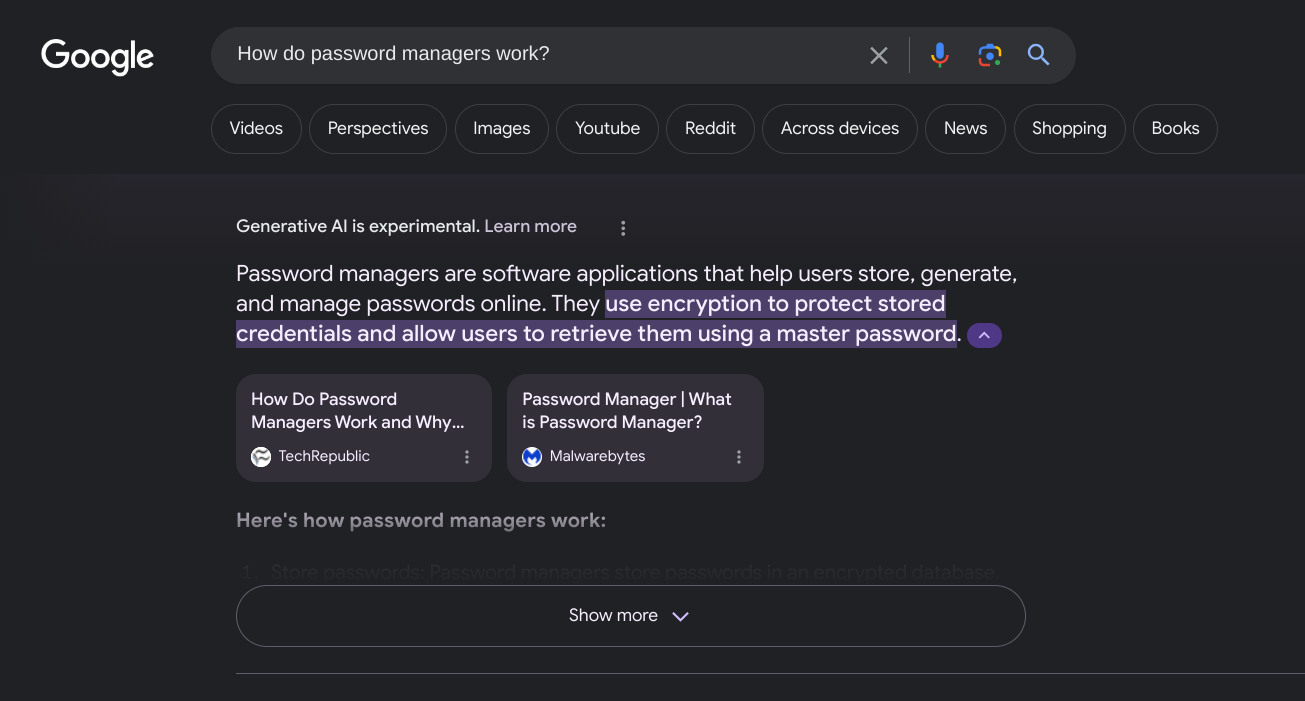
But the top-of-funnel questions based on what, why, and how can all be handled by AI easily. These are questions like:
- How do password managers work?
- What is a password manager?
- Why are password managers important?
If you search any of these on Google, you’re going to get a generative search answer.
Concerns With AI-Generated Content and How To Rethink Them
There are numerous concerns regarding AI-written content, each reflecting the organization’s values, objectives, and concerns about the implications of AI technology.
I was nervous that I might not think of all possible client concerns, so I actually used AI to help me with my research. These are the concerns AI helped me uncover:
- Quality and Authenticity: A primary concern might be maintaining a high standard of content quality and authenticity. AI-generated content will always lack nuanced understanding, depth, or emotional resonance.
- Trust and Credibility: Clients might worry that relying on AI could erode their audience’s trust, especially if the audience values expert human insights or if the AI-generated content is perceived as less reliable or prone to inaccuracies. I would also argue that this is taken care of by human writers of lower-funnel content.
- Ethical Considerations: The use of AI in content creation raises ethical questions, including the potential for spreading misinformation, the difficulty in ensuring fairness and unbiased perspectives, and concerns over intellectual property rights.
- Brand Identity: The unique voice and perspective of a brand or platform are crucial differentiators. There might be a belief that AI cannot fully capture or convey the brand’s identity and values with the same authenticity a human content team can. This is another area where the client is right to have this fear.
- Engagement and Interaction: Human-created content often reflects the creator’s personality, experiences, and the ability to engage with audience feedback in a dynamic, empathetic manner. There might be concerns that AI-generated content could lead to a decline in audience engagement and interaction. Again, your content strategist will foresee this and ensure content that is meant for engagement is written by humans for humans.
- Regulatory and Legal Concerns: With the legal landscape around AI-generated content still evolving, there may be concerns about potential future regulations, copyright issues, and the use of copyrighted material within AI-generated outputs.
- Economic and Employment Impacts: There’s also the consideration of the economic impact on content creators. Banning AI-generated content can be a way to protect jobs and ensure that the field remains viable for human writers and creators. Right now, I don’t think companies are as concerned with this as they are with ROI.
It’s hard not to agree with clients, given all of these concerns. So the best way I can think of to alleviate their fears is to have a frank conversation about AI and how you’ll use it.
You should absolutely use AI for data analysis, technical SEO, and whatever little bits of coding you need to improve your site’s SEO.
I’ve used AI for each of these tasks. I can better analyze large sets of data to ensure my sites are correctly organized. I can also identify potential keywords that audiences are using to find the information they need. I’ve also used it to help create small snippets of code in HTML and CSS to help me tweak small areas of websites.
But I don’t use it to write entire articles.
Note that Google has published it’s stance on AI-generated content. You’ll immediately see they seem OK with AI-generated content, as long as it doesn’t fall into or violate their spam policies on automatically generated content.
Don’t Let Your Fear of AI Ruin Your Content Strategy
What does this mean for business owners?
It doesn’t mean that you should compromise your brand or voice across your content channels. In fact, focusing on your brand and voice is extremely important, especially in modern internet marketing.
It’s important because the search engines have changed and now prefer, or give more weight, in search results to established brands. This is where Google’s E-E-A-T guidelines are supposed to weigh heavily in search rankings.
In other words, brands that have been around and are well-known.
Small and midsized businesses can still compete, but you’ll want to consider working closely with a content strategist early in your business’s life. It’s a tough call to make, especially on a limited budget, but if you include this cost in your initial business planning, the foresight will pay off.
Address AI as Part of Your Content Strategy
You’ll want to have a direct and frank conversation with your content strategist about how they plan to use AI. Ideally, they’ll be upfront with you about their policy on AI and how its used in their strategies.
I think AI is a great tool that should be used as just that: a tool. The way I think of it is this: You would use a screwdriver to help you screw something together. You wouldn’t have the screwdriver do it for you.
It should be the same for AI-generated content. You can use the AI as a tool to extract website data, come up with topic ideas, and create outlines. But it’s best to have humans write the content to ensure that human touch is there.
Notes:
- The marketing funnel is a theoretical model that maps your customer’s journey from unawareness of your product or service to awareness, then interest and desire, and finally purchase or action.
- Google’s E-E-A-T guidelines are meant to ensure that all content is created by topical experts who have experience and authority in the topic, signifying that they’re thought leaders whose knowledge and experience can be trusted.
 Deven Bhagwandin