
If you’re reading this, you’re probably fed up with the internet.
You’re probably tired of seeing the same brands and links at the top of search results. You may even be a brand owner, writer, or content creator who’s pissed because your content isn’t clicked on enough.
Internally or even outwardly, you may think that Google is biased and isn’t helpful anymore.
Well, you’re on to something, so trust your gut because we’re at a crossroads in how search engines deliver results.
The Verge Article
I like SEO. I like working in content marketing.
I like the psychological and psychographic aspects of getting to really know your target audience intimately, solving their issues or simply helping them.
I find this really cool because I can get to know audience habits and behaviors at scale. And, like it or not, humans have collective behavior patterns, even when it comes to online behavior.
The study of these patterns is called cyberpsychology. You may have heard this term, or you may have heard it called internet psychology or web psychology, but essentially, it’s the study of human behavior in relation to the internet.
There are entire branches of this discipline called user experience and human-computer interaction, and Google has entire teams and divisions dedicated to each.
Mia Sato accuses Google of exploiting its research and development of these studies in her January 8, 2024, article.
Google argues that it’s simply using its findings to be helpful.
| Whatever the case or what you think, SEO and its implementation boil down to one thing: data analysis. |
Google and marketers can analyze data to make educated guesses on how to improve websites, build brands, or sell products.
We can see what users like and don’t like. We can see how they arrive on sites, what they do while they’re on the site, and where they go after leaving the site.
We can see what terms they use to find information and what sites they click on the most after using certain terms.
Then, we use that information to write content that we hope will land in front of their eyes and entice them to click on it.
In the end, business owners hope they make money from these tactics.
And newsflash: the internet is about making money. Its original intention of sharing information with the world has been grossly taken advantage of, and it’s not used for how it was originally envisioned.
So, if Mia Sato is unhappy with search results and how the internet works, she can blame capitalism.
My Thoughts
I’m well aware that I’m doing what Sato and The Verge want: addressing their article, engaging in a discussion about its content, and linking to it.
But guess what ELSE I’m doing? The link I’ve included is helpful to readers who are curious about the article. I’m giving them an easy way to find out more.
This backlink helps The Verge’s SEO (eventually, when I get more readers on my site).
My colleagues and those I follow who’ve linked to the article also help its SEO (even though we’re not 100% happy with it).
And we’re creating buzz around it on different apps, which ALSO helps with The Verge’s SEO.
Sato and The Verge know this. Sato even acknowledges this in the article.
| The Verge and Sato may not see it, but the internet is still all about helping people. |
People create businesses to help each other.
So what we have now is an internet where people are trying to help other people sell things. And SEOs and content marketers create strategies and content that help businesses make money.
Is there anything wrong with getting paid for any of that? Are you unhelpful if you’re charging a fee for a product or service?
Is that what Sato is implying?
We know altruism still exists, and there are people who post things simply to help others, with no capitalistic interests whatsoever.
But even those websites or posts that have zero intent of making money need SEO, or they’ll never be found, right?
And those websites all look the same because, after analyzing all the data, we’ve noticed there is a certain website architecture and structure that works best.
Yes, occasionally, there are some really great, innovative sites. I personally think that Richard Perry’s animations in Sato’s article are really creative, and I hope to see more of these on the sites I frequent if the load time doesn’t interfere with the page experience.
But for the most part, people are using the internet to find a product or answer a question, and this is what the data shows is the best way to organize things.
What SEOs Are Saying
Most of my network didn’t want to waste their valuable time addressing this article beyond saying they’re annoyed with it and The Verge.
I did some digging on X and LinkedIn and generally got the same consensus: SEOs are really just wondering why The Verge is going after them, and what’s the point?
Some of the best speculation is that The Verge itself is losing search rankings and needs a “win.” Other SEOs make a good point: Are non-SEOs even reading this article?
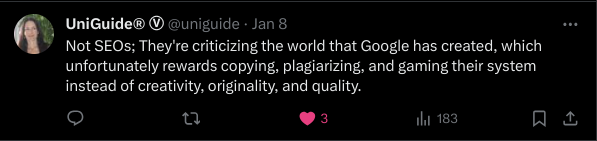
This one from @uniguide offers some truth, unfortunately.
I plan to keep talking to others as time passes, and I’ll add more here if anything major is stated.
What is the Verge’s Purpose in Publishing These Articles?
What’s going on over at The Verge? They had to know that SEOs would pick this article apart…and we did.
Sato’s an accomplished investigative reporter, but in this case, what exactly is she uncovering?
Is she accusing SEOs and Google of sitting on this information? Because the article reads as an “expose,” as if this big scandal is finally being exposed for the world to see.
That’s absurd since a lot of this information is freely accessible.
Final Thoughts
The Verge and Sato got me. I heard about this article and rushed to click and read it. It pissed me off, so I messaged, commented, shared, engaged, and took inspiration from it.
So…it’s proof that a well-planned, well-written article that is keyword-rich and has a clear target audience is going to get engagement and draw eyes to your brand.
Bottom Line: SEO is here to stay; it works; it’s just another way of ensuring your business gets a leg up over its competitors, so use it to your advantage.
 Deven Bhagwandin